Indigenous Perspectives on Meaningful Work: Lessons from Adam Murry and Alvan Yuan

In this episode of Meaningful Work Matters, host Andrew Soren sits down with two researchers who are enhancing our understanding of meaningful work through an Indigenous lens.

Dr. Adam Murry, an associate professor of psychology at the University of Calgary with Ukrainian, Irish, and Apache heritage, and his graduate student Alvan Yuan, a Canadian of Taiwanese descent, offer an exploration of Indigenous perspectives in workplace settings.

Drawing from their extensive research in post-secondary institutions, Murray and Yuan go beyond describing workplace experiences. They provide a comprehensive analysis that challenges existing paradigms of meaningful work, offering practical insights for leaders and organizations seeking to create more inclusive, purposeful work environments.

Their study explores the complex ways Indigenous faculty and staff in post-secondary institutions define, experience, and navigate professional purpose, while also presenting actionable strategies for organizational transformation.

The Research Journey

The conversation begins with the backstory of their research, which emerged from a critical question posed by university leadership: How can we retain and support Indigenous faculty and staff?

Murry explains that this wasn't just another academic exercise, but a deeply purposeful investigation prompted by concerns about Indigenous employees being recruited away from their institutions.

The researchers interviewed 18 Indigenous faculty and staff from universities across Western Canada, focusing on understanding their experiences of meaningful work. Their approach was deliberately collaborative, rooted in Murry's long-standing commitment to research that genuinely serves Indigenous communities.

Redefining Meaningful Work

Through their interviews, Murry and Yuan uncovered an holistic understanding of meaningful work that extends far beyond traditional workplace metrics. For the Indigenous employees the spoke with, work is intrinsically linked to broader concepts of community, ancestry, and collective purpose.

Three key dimensions emerged as central to their sense of meaningful work:

1 Generational Belonging - seeing work as a continuation of ancestral labor and a service to both current and future generations. This perspective transforms work from an individual pursuit to a collective journey of community advancement.

2 Connectedness - not just to immediate colleagues, but to community, land, and cultural context. This connectedness is far more comprehensive than typical workplace understanding of team dynamics.

3 Job Design - finding meaning in work that directly aligns with Indigenous causes or personal cultural beliefs. The job itself becomes a vehicle for cultural preservation and community empowerment.

The Invisible Labor of Indigenous Professionals

Murry and Yuan don't shy away from naming the systemic challenges Indigenous employees face.

They describe what they term the "minority tax" - an invisible burden of additional unrecognized labor. Indigenous faculty and staff are simultaneously expected to represent entire Indigenous experiences while managing traditional job responsibilities, all while confronting deep-rooted colonial structures within institutions.

The researchers highlight a critical tension: organizations frequently seek to leverage Indigenous employees' community-driven values without providing adequate support, recognition, or compensation.

This dynamic often leads to burnout, frustration, and a sense of exploitation.

Pathways to Organizational Transformation

The research offers compelling recommendations for meaningful change. Murry and Yuan advocate for a radical reimagining of workplace structures that goes beyond surface-level diversity initiatives.

Key strategies include:

  • Providing genuine job crafting opportunities

  • Encoding community-focused work into formal job descriptions

  • Creating promotion criteria that truly recognize Indigenous contributions

  • Allowing Indigenous employees to define decolonization on their own terms

Decolonization as a Workplace Journey

The researchers frame meaningful work as a potential avenue for reconciliation - a space where systemic barriers can be challenged and transformed.

They draw on the powerful insight that decolonization is not just an institutional mandate, but a deeply personal process of reclaiming narrative and purpose.

Conclusion

Murry and Yuan invite us to expand our understanding of meaningful work.

They challenge us to recognize that career purpose is a deeply personal journey shaped by cultural context, historical experiences, and collective aspirations.

For organizations seeking greater diversity, equity, and inclusion, this research offers a transformative roadmap - one that honors the rich, multifaceted experiences of Indigenous professionals and reimagines workplace culture through a lens of genuine respect and mutual understanding.

Resources Mentioned

Beyond Perfect Performance: Lessons from Sonya Looney

In this episode of Meaningful Work Matters, host Andrew Soren explores the intricate relationship between perfectionism and meaningful work with Sonya Looney, a unique voice at the intersection of elite performance and well-being. As a World Champion mountain biker with two decades of endurance racing experience, NBC-HWC-certified mental performance coach, and researcher, Looney brings both scientific rigor and lived experience to the conversation. Her unique combination of athletic achievement, coaching expertise, and interdisciplinary education allows her to offer distinctive insights into resilience, healthy striving, and the complex dynamics of perfectionism in high-performance settings.

Understanding Perfectionism in High Achievement

Looney introduces perfectionism through the multi-dimensional model developed by Flett and Hewitt, which identifies three key dimensions:

"We're perfectionistic in three ways: We have very high standards for ourselves, we have very high standards for other people, or we expect to meet other people's standards, society's standards, someone else's standards."

This framework helps explain why many high achievers struggle to find satisfaction in their accomplishments, often experiencing what Looney describes as "excessive striving, self-validation through goals, and difficulty in realizing a sense of accomplishment."

The Paradox of Performance and Purpose

One of the most striking insights from the episode is how perfectionism can actually undermine the meaningful aspects of work.

Through her personal journey as an elite athlete, Looney discovered that her most fulfilling moments weren't tied to race victories or performance metrics, but rather to the impact she had on others.

"If I win a race, I don't really care anymore. It's more how can I use this experience? How can I use my bike racing as a laboratory to help other people unlock their potential and find fulfillment in the process?"

From Personal Achievement to Social Impact

Looney's research reveals a shift in how we might approach goal-setting and achievement.

She introduces the concept of "meaningful other-ish goals," building on Adam Grant and Reb Rebele's work on "other-ish" behavior, where personal achievement becomes a vehicle for broader social impact.

Understanding Other-ish Goals
  • Combine personal achievement with social contribution
  • Focus on collective impact rather than individual success
  • Allow for both personal growth and community benefit
  • Emphasize immeasurable impacts over quantifiable metrics

The Challenge of Immeasurable Impact

A paradox emerges in Looney's work: the most meaningful accomplishments are often the ones we can't measure. As she notes:

"Maybe the immeasurability of it is actually helping perfectionists because they can't compare it to something. It's just a feeling and it's immeasurable."

This insight challenges traditional approaches to performance evaluation and success metrics, suggesting that our most significant contributions might exist beyond conventional measurement frameworks.

Practical Applications for Perfectionists

Looney offers several strategies for high achievers struggling with perfectionist tendencies:

  1. Balance your ‘goal portfolio’ between personal achievement and social impact

  1. Practice intentional savoring of accomplishments, especially focusing on impact on others

  2. Recognize that negative emotions can coexist with meaningful achievement

  3. Consider reducing measurement frequency of performance metrics

Resources for Further Exploration

Beyond the Billable Hour: Lessons from Anne Brafford [Parts One & Two]

In this two-part episode of Meaningful Work Matters, host Andrew Soren explores the complex intersection of meaningful work, identity, and the legal profession with Dr. Anne Brafford. A former Big Law equity partner turned well-being consultant and researcher, Brafford brings unique insights from both her personal journey and her academic research into how lawyers find - or struggle to find - meaning in their work.

Brafford is the owner of Aspire, an education and consulting firm for the legal profession, and a founder of the Institute for Well-Being in Law. Her work focuses on the intersection of inclusion, engagement, and well-being in legal workplaces, informed by both her practical experience as a former equity partner at one of the nation's largest law firms and her academic credentials - a PhD in positive organizational psychology from Claremont Graduate University and a Masters of Applied Positive Psychology (MAPP) from the University of Pennsylvania.

A Journey from Dream to Reality

Brafford's relationship with law began early - at age 11, she already knew she wanted to be a lawyer. As a first-generation college student who went on to achieve her childhood dream, becoming not just a lawyer but an equity partner at a prestigious firm, her story exemplifies both the allure and complexity of pursuing meaningful work in the legal profession.

What drew her specifically to employment law was its inherent connection to human psychology and problem-solving - themes that would later influence her transition into well-being research and consulting.

However, after achieving the pinnacle of success in Big Law, Brafford found herself grappling with questions about meaning and purpose: "After the achievement ran out… then there wasn't much left as far as meaningfulness went."

The Moral Dimension of Legal Practice

Brafford shares a powerful story about her mentor Carol, who demonstrated how lawyers could provide both legal and moral guidance to clients.

In an environment where law is often approached as amoral, Carol stood out by consistently incorporating ethical considerations alongside legal risk assessments.

Moral Leadership in Practice
  • Going beyond legal risk assessment to consider ethical implications
  • Acknowledging the human impact of business decisions
  • Building trust through consistent demonstration of care for broader interests
  • Creating space for moral reflection in client conversations

"My mentor would get involved in very tricky employment issues, like discharge issues always have a lot of moral weight to them," Brafford explains. "You're taking a person's livelihood away from them. But sometimes our clients forget that.

This approach manifested in practical ways, such as advising clients not just on legal risk but on moral implications - like the impact of terminating an employee just before their pension vested. Carol's example gave Brafford "permission and courage to develop more of that moral sensibility" in her own practice.

Identity and Gender in Legal Practice

Brafford's research illuminates patterns in how gender shapes career motivations and experiences in law. While law schools have maintained gender parity for decades with roughly 50% female enrollment, only 20-30% of law firm partners are women. This dramatic drop-off points to deeper systemic issues around how different identities experience and pursue meaningful work.

Her research reveals that women lawyers consistently cite meaningful work as a primary motivator for their careers, while men more frequently emphasize financial success and provider roles. These differences reflect broader societal patterns and expectations that shape how men and women approach their professional lives.

"When work gets hard, men can find more value in their provider role of this is hard, but I'm doing this for my family," Brafford notes. "Women who have not been socialized into that role... when it gets hard and meaningfulness is being drained, there's a bigger question of why am I doing this?"

Positive Changes in Legal Organizations

The conversation reveals encouraging developments in how law firms are evolving to create more meaningful work environments.

The COVID-19 pandemic, coupled with broader societal movements, has catalyzed significant cultural shifts. Law firms are increasingly taking public stances on important social issues and articulating clear organizational values - a dramatic departure from their traditionally neutral positioning.

Brafford highlights one particularly innovative example: a law firm's groundbreaking parental leave policy that challenges traditional hierarchies by offering expanded leave options that apply equally to all employees - not just lawyers. This approach recognizes that meaningful work environments must address both the professional and personal needs of their people.


In part two of our conversation with Dr. Anne Brafford, she delves into Self-Determination Theory (SDT) - a framework for understanding human motivation and flourishing that has profound implications for creating meaningful work environments.

Understanding Self-Determination Theory

At its core, Self-Determination Theory proposes that people share three basic psychological needs essential for optimal functioning and motivation: relatedness, competence, and autonomy.

As Brafford explains:

"We either need to figure out how to satisfy these needs ourselves, or even more so, our context needs to help support those needs."

Relatedness encompasses both close interpersonal relationships and a sense of belonging within significant groups or communities.

Competence reflects the need to feel effective and see that actions impact the environment.

The third need, autonomy, is often misunderstood. "Under self determination theory, autonomy isn't about independence," Brafford clarifies. "It's more about volition and authenticity - do I feel like I'm doing this because I'm being compelled, or do I feel that I am self-authoring, doing it because I am choosing to and because it aligns with my values and identities?"

The Quality of Motivation

Beyond identifying these core needs, SDT revolutionized our understanding of motivation by moving away from simple "on/off" models. Instead, motivation exists on a continuum of quality, ranging from amotivation (complete lack of motivation) through various forms of external motivation to fully autonomous motivation.

"What the theory proposes is that when our needs are satisfied in our context, we are more likely to be autonomously motivated in that context," Brafford explains.

This quality spectrum includes:

  • Amotivation: No motivation or connection to the task at hand

  • External motivation: Acting due to force or external rewards

  • Introjected motivation: Partially internalized but driven by guilt or ego

  • Identified motivation: Actions aligned with personal values

  • Integrated motivation: Full alignment across all aspects of identity

  • Intrinsic motivation: Acting from pure enjoyment or interest

Creating Conditions for Meaningful Work

The research shows remarkable connections between autonomous motivation and meaningful work. "What the research has found is that autonomous motivation is really strongly related to meaningful work - like 0.83 in one study," notes Brafford. "You're just not going to get meaningfulness at work unless you have autonomous motivation."

This insight has profound implications for leadership. Rather than relying on command-and-control, effective leaders focus on understanding what matters to their people and helping create conditions where they can connect their work to their values.

Supporting Psychological Needs in Practice

For organizations and leaders looking to foster meaningful work environments, Brafford emphasizes several key practices:

  1. Get to know people as individuals - understand their values, interests, and priorities

  2. Help frame the significance of work in ways that connect to what matters to them

  3. Structure work to support feelings of competence and growth

  4. Create opportunities for high-quality relationships and belonging

  5. Allow appropriate autonomy in how work gets done

Individual Agency in Need Satisfaction

While organizational support is crucial, Brafford also highlights the importance of individual "needs crafting" - proactively shaping our work to better meet psychological needs. This requires self-awareness and mindfulness about values and needs, along with the psychological flexibility to pursue them effectively in the moment.

Looking Ahead

The implications of Self-Determination Theory extend far beyond individual workplace satisfaction.

When organizations create environments that support basic psychological needs, they see improvements in engagement, wellbeing, performance, and retention. This science-based approach offers practical pathways to make work more meaningful for everyone involved.

Resources for Further Exploration

The Virtuous Organization: Lessons from Kim Cameron

This Meaningful Work Matters episode features Kim Cameron, a renowned expert in positive organizational scholarship and a faculty member at the University of Michigan's Ross School of Business.

Andrew and Kim discuss the essence of virtuous organizations and the incredible transformation they can bring about. Kim shares insights from his extensive research, including eight key dimensions pivotal in fostering an organization's virtuousness. From gratitude and appreciation to trust and integrity, these dimensions create a holistic environment for individuals to flourish.

Discover inspiring real-life stories of organizations that have embraced virtuousness in their cultures, even during challenging times like downsizing or a pandemic. This conversation with Kim Cameron is a must-listen if you want to understand how virtuous organizations can positively impact performance, well-being, and culture.

Stay connected with Meaningful Work Matters on your favorite podcast platform. Hit that "Follow" button to receive timely updates on new episodes and bonus content. If you love what you hear, take a moment to rate the podcast and leave a review. It helps us reach more listeners and build a community around meaningful work.

Positive Deviance Defined

Kim Cameron has been one of the driving forces behind Positive Organizational Scholarship (POS), an area of research that explores the what, how and why of positively deviant organizations. Organizations that are positively deviant go way beyond the usual expectations or norms. Not only do they achieve bottom-line performance, they also enact virtuous behavior, cultivate positive work culture, foster resilience, create inclusive growth and foster sustainable practices.

The Eight Dimensions of Virtuousness

Cameron identifies eight dimensions that contribute to virtuousness within organizations. These dimensions, when institutionalized, have been directly linked to high performance.

  1. Gratitude and Appreciation: Recognizing employees' contributions through gratitude practices that make people feel valued and valuable.

  2. Dignity and Respect: Work environments where all individuals are treated with dignity and are respected for their inherent worth.

  3. Support and Compassion: Providing empathetic support to employees, especially when facing challenges or difficulties.

  4. Caring and Concern: Closely related to compassion, it creates an environment where employees feel their well-being is a priority.

  5. Meaningfulness and Purpose: having a profound organizational purpose beyond transactional objectives and ensuring employees find meaning by understanding how they contribute to it.

  6. Positively Energizing Activities: Fostering positive energy through activities and behaviors that help others to dream, do, become, learn, and flourish.

  7. Forgiveness and Understanding: Fosters a culture where mistakes are seen as opportunities for growth and learning, promoting an atmosphere of forgiveness.

  8. Trust and Integrity: Ensuring that the organization operates with honesty and ethical principles, which in turn builds trust among employees and stakeholders.

These eight dimensions collectively contribute to an organizational culture that is not just focused on achieving financial success, but also on fostering a positive, virtuous, and supportive work environment. This holistic approach to organizational success is what differentiates such organizations and leads to exceptional performance across various metrics.

Virtuous Organizations in Action

In Derby, Connecticut, Griffin Hospital faced severe challenges, including a reputation for poor service, particularly in its OBGYN department. The crisis escalated when a respected director of operations, Pat Charmel was fired, sparking staff uproar. Employees, valuing Charmel's leadership, boldly interrupted a board meeting, demanding his reinstatement and the executives' dismissal. The board acquiesced, appointing Charmel as both President and CEO.

Charmel quickly addressed the hospital's negative image and discovered financial mismanagement by the previous CEO. Facing potential bankruptcy, he had to make tough decisions, including downsizing, which affected some of his strongest supporters.

Despite these hardships, Charmel's compassionate approach and strategic leadership turned the hospital around. Under his direction, Griffin Hospital recovered and thrived, especially during the pandemic. It prioritized community health by providing COVID testing and vaccination services to vulnerable populations, emphasizing virtuous, community-focused actions over immediate profit.

Courageous Leadership in Virtuous Organizations

To truly listen and be innovative like Pat Charmel requires taking risks. Cameron talks about the kind of courageous leadership and unequivocal support from the top that is required in virtuous organizations. However, change cannot be top-down only; it needs involvement and buy-in from all levels. That means that a critical attribute of leadership in virtuous organizations is the capacity to cultivate a culture of support, innovation, and inclusive change.

Positive Energy and Resilience During Adversity

Cameron illustrates the point by discussing the University of Michigan's Business and Finance Group, where ‘positive energizers’ were identified and empowered to effect change. The energizers were tasked with a challenge to spread positive practices across the organization. These practices ranged from small gestures like bringing flowers to larger systemic changes like reward system overhauls. Remarkably, even during the pandemic, this approach led to significant improvements across various dimensions, proving that positive energy and innovative, people-focused initiatives can build resilience and drive improvement, even in adversity.

Ethics and Empirical Evidence in Virtuous Organizations

Discussing the ethical dimensions of virtuous organizations, Cameron places ethics as a mid-point in a continuum, with unethical behavior on one end and virtuousness on the other. He advocates for organizations not just to avoid harm but to actively do good. Cameron argues that empirical evidence showing the positive impact on bottom-line results can inspire leaders to adopt virtuous practices.

Cameron’s insights highlight the transformative power of virtuousness within organizations. By institutionalizing positive practices, organizations can achieve extraordinary outcomes while fostering employee flourishing.


The Double-Edged Sword of Meaningful Work: Lessons from Andrew Soren

In the bustling world of work and productivity, the quest for meaningful work has become a north star for many. But is all meaningful work beneficial?

Andrew Soren, founder of Eudaimonic by Design, hosts the debut episode of Meaningful Work Matters, which delves into the intricate dance between the highs and lows of engaging in work that matters deeply to us.

The Allure of Meaningful Work

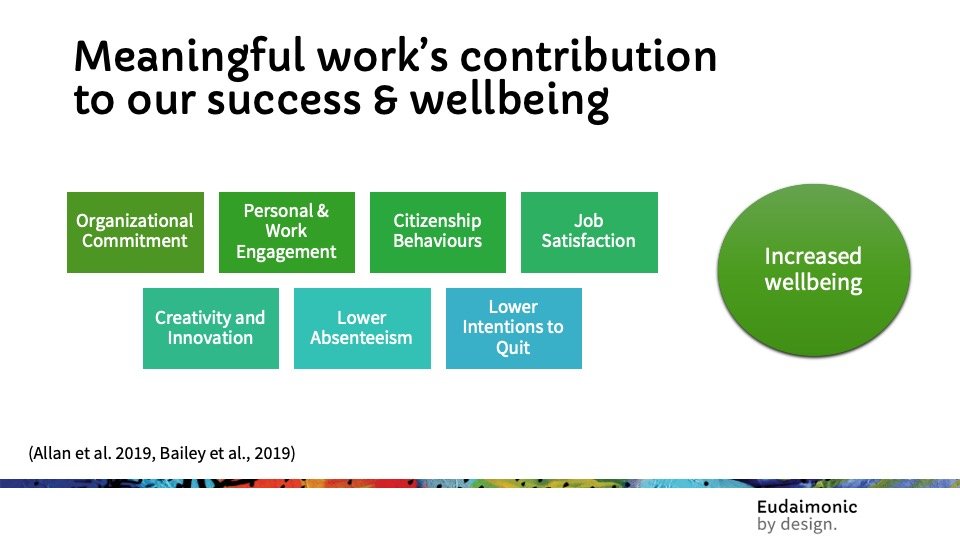
Meaningful work is not a luxury but a fundamental component of our well-being. As Andrew elucidates, work that feels significant and worthwhile can enhance our commitment, engagement, and satisfaction. The benefits extend beyond the personal sphere, fostering a culture of creativity, innovation, and altruism within organizations.

The Hidden Costs

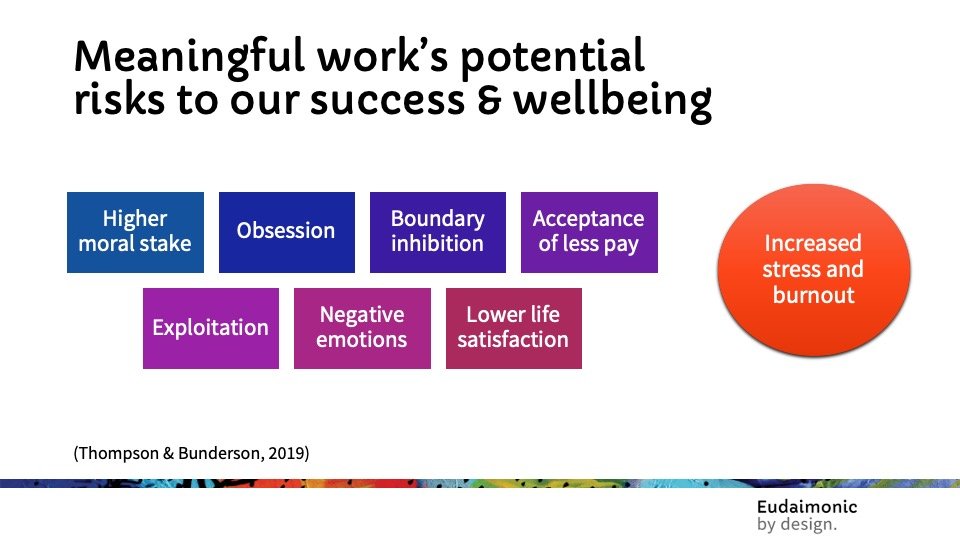
The research also reveals the dark sides of meaningful work: the potential for exploitation and burnout. When work has a high moral stake and becomes an obsession or when employers leverage our passion without decent working conditions, meaningful work can transform from a source of fulfillment into a wellspring of dissatisfaction, stress, and burnout.

The Crucial Element of Decency

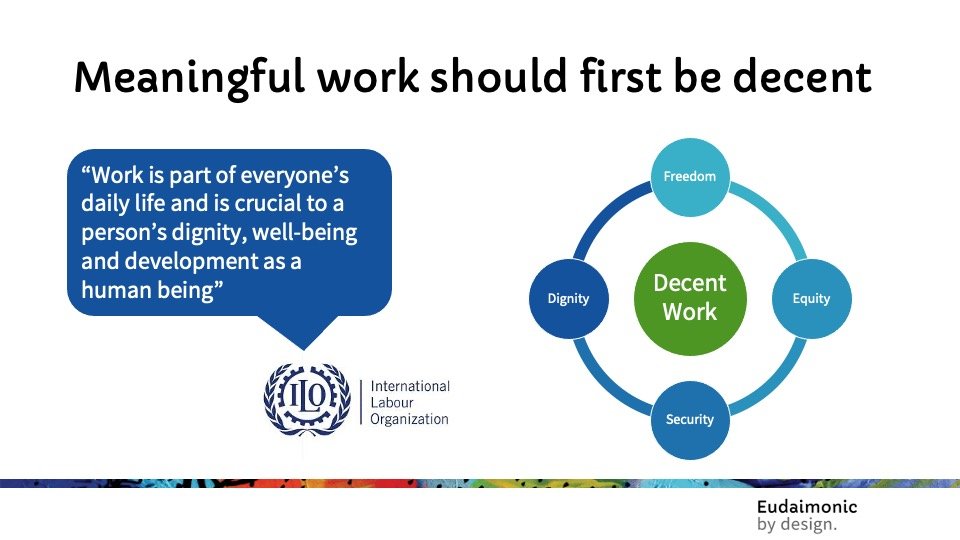
Central to the discussion is the concept of "decent work" - safe, equitable, and dignified work. Drawing from the principles set by the Industrial Labor Organization, Soren advocates for a balance between meaning and decency. He argues that meaningful work, devoid of decency, can lead to exploitation and burnout. Conversely, work grounded in respect, equity, and security paves the way for true fulfillment.

Navigating the Path Forward

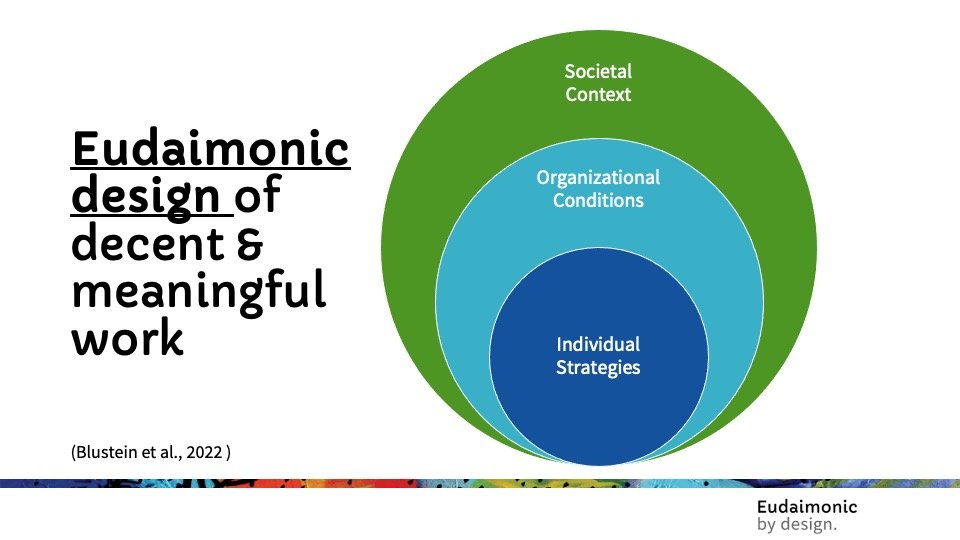
Andrew presents a blueprint for cultivating environments where meaningful and decent work can thrive. We need policies and regulations to ensure decent working conditions for those engaged in meaningful work. In organizations, we can design the cultures, practices, and leadership behaviors that enable those engaged in meaningful work to thrive. At the individual level, we can create interventions to help people understand what makes work personally significant and worthwhile and craft work that makes the most of an individual's strengths, values, and passions.

Your Role in Shaping Meaningful Work

As listeners, we're invited to reflect on our workplace and community roles. Whether you're a leader, policymaker, or team member, this podcast encourages you to consider how you can contribute to a more equitable and fulfilling work culture.

Join the Conversation

Meaningful Work Matters is not just a podcast; it's a call to action. As we navigate the complexities of the modern workforce, let's engage in conversations that matter. Share your thoughts, experiences, and aspirations with us. How do you define meaningful work? What steps can we take to ensure that work is meaningful and decent?

Visit our Resources page for insights and discussions on creating a better world through meaningful work. Together, we can make work a source of joy, growth, and fulfillment for all.

Resources to explore: