Organizational Psychology

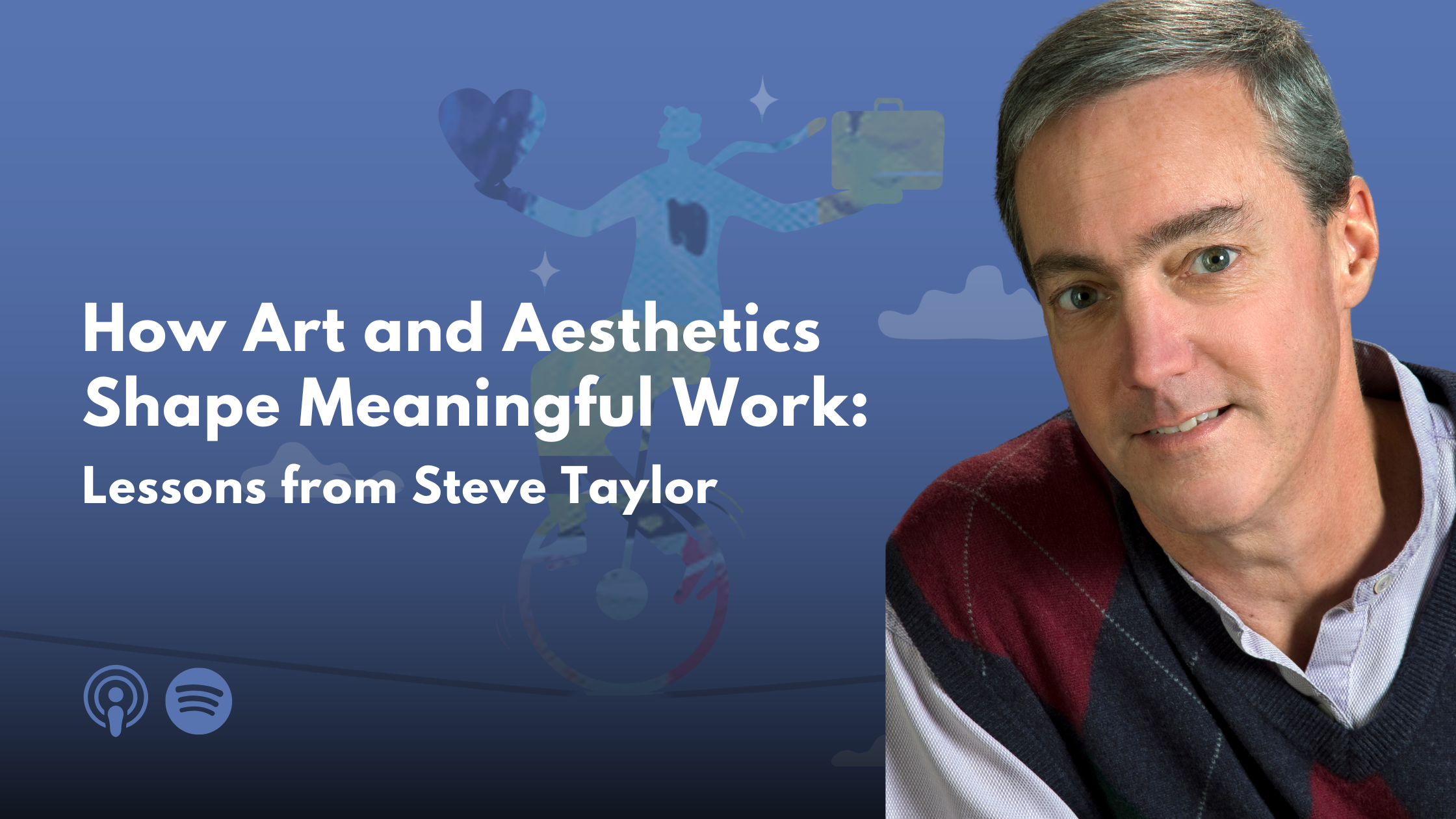
How Art and Aesthetics Shape Meaningful Work: Lessons from Steve Taylor

In this episode of Meaningful Work Matters, Andrew speaks with Steve Taylor, professor of leadership and creativity at the WPI Business School. Taylor’s work lives at an unusual intersection of organizational life, ethics, and the arts. He studies not only how people think about work, but how they experience it through their senses, their bodies, and their relationships.

Taylor argues that our dominant ways of studying and designing work privilege logic, metrics, and language, while ignoring sensory knowing, aesthetic judgment, and embodied experience. When those dimensions are excluded, something essential about work disappears.

This matters now more than ever. As organizations become more automated and abstract, and as AI absorbs more analytical and linguistic tasks, the distinctly human capacities of discernment, judgment, and aesthetic sensitivity become harder to ignore. Taylor invites leaders and practitioners to consider a different way of knowing work, one that values not having the answer, staying close to experience, and learning through artful practice.

Meaning Is Experienced

A core theme of the conversation is that meaningful work is something we feel before we explain it. Taylor draws on the tradition of organizational aesthetics, which traces back to the original meaning of aesthetics as sensory perception rather than beauty or surface appearance.

He explains that humans apprehend the world first through sensation.

“We actually know things through sensory knowing, through the direct experience of our senses.”

We notice tone and rhythm, moments of tension or ease, and subtle forms of discomfort that shape how work is experienced long before it is interpreted. Only later do we translate those sensations into emotions, and later still into concepts or explanations. In organizational life, however, this sequence is often reversed. People are asked to articulate purpose and meaning in abstract terms, while the sensory conditions that make work feel enlivening or draining remain largely unexamined.

Taylor suggests that this gap helps explain why many conversations about work feel thin or disconnected. People can describe what should matter, yet struggle to connect that language to lived experience. Aesthetic awareness offers a way back into that connection by inviting questions such as what a meeting feels like in the body, where resonance or dissonance shows up, and how the texture of a workday shapes engagement over time.

These questions influence how people relate to one another, where they withdraw, and how commitment forms or erodes. Meaning emerges through relationship and felt experience with others, shaped by everyday interactions rather than individual reflection alone.

Art as a Way of Knowing What We Cannot Say Yet

Taylor’s own path into this work emerged through playwriting. When he was unexpectedly laid off early in his career, he did not begin by analyzing the experience. Instead, he wrote a scene, which later became a play. Through that process, the experience took form outside his body, making it easier to see and engage with.

Years later, he returned to the same experience through cognitive analysis, at which point the emotional and sensory work had already been done. The art had created a foundation for understanding by giving shape to something that initially felt overwhelming and difficult to articulate.

This pattern appears throughout Taylor’s work.

“Art allows you to make your feelings object in the world, so you can see them and others can see them.”

Art allows people to make inner experience visible, even when its meaning is not yet clear. As Taylor puts it, art makes feelings “object in the world,” where they can be seen, shared, and reflected on.

He does not frame art as a replacement for analysis, but as a companion that often comes first. Cognitive frameworks tend to land more effectively after experience has been processed at a sensory and emotional level. Without that grounding, analysis can drift away from what people are actually living through.

This is part of what gives arts-based methods their power in leadership and organizational development. They surface what is already present but unspoken, bringing forward tensions, contradictions, and patterns that formal language often smooths over.

Seeing Power and Complexity Through Aesthetic Practice

One of the most practical dimensions of the conversation focuses on how aesthetic awareness changes the way people perceive power and interaction at work.

Taylor describes using techniques from theater, particularly status work developed by Keith Johnstone, to help students and leaders recognize the micro-dynamics of power that shape everyday interactions. Status reveals itself through posture, eye contact, pacing, and tone, with people enacting higher or lower status constantly, often without conscious awareness.

When participants work with these dynamics physically, insight begins to emerge in ways that discussion alone rarely produces. Small shifts in behavior start to feel consequential. A leader who lowers their physical stance can invite openness, while a team member who becomes aware of habitual self-minimization can experiment with different ways of showing up.

Beyond power dynamics, the arts also help people stay with complexity rather than rushing toward simplification. Taylor references research comparing traditional leadership training with arts-based learning, where participants who focused on leadership theories tended to reduce complexity, while those who engaged deeply with art, music, and literature developed a greater tolerance for ambiguity.

This distinction matters because expertise does not eliminate complexity.

Leadership depends on discernment, the ability to sense what matters in a given moment, and art trains this capacity by resisting easy answers and inviting sustained attention.

The Risks and Limits of Bringing Art Into Organizations

Taylor is clear that arts-based approaches are neither neutral nor risk-free. Art can surface experiences that people are not prepared to confront, and in rare cases, it can open emotional material that requires care and support.

Organizations also tend to instrumentalize the tools they adopt. Artistic methods may be used to extract insight without fully honoring what is revealed. Leaders may invite aesthetic exploration with curiosity, only to recoil when it exposes uncomfortable truths about power, culture, or responsibility.

This tension is difficult to avoid. Art reveals rather than reassures, and it resists control. Once work moves into the sensory and experiential realm, managerial certainty begins to loosen, and outcomes become less predictable.

This uncertainty helps explain why many organizations hesitate to engage this territory seriously. At the same time, it points to why the work remains essential. Meaningful work grows out of engagement with what is real, including aspects of experience that cannot be neatly managed.

Discernment in an Age of Automation

As the conversation turns toward the future of work, Taylor introduces a critical idea. In a world where AI increasingly handles analysis and language, human value shifts toward judgment and discernment.

Discernment involves noticing what matters, including what is subtle, missing, or unlikely.

“What I want in a leader is discernment, the ability to notice what matters and know what it means.”

Taylor evokes Sherlock Holmes’ attention to the dog that did not bark, a detail whose absence carried more meaning than what was immediately visible. This kind of perception depends on sensory awareness, experience, and aesthetic judgment developed over time.

As automated systems grow more capable, the human contribution lies less in producing answers and more in recognizing significance. Aesthetic sensibility supports this capacity by helping people sense importance before it can be fully named or explained.

For Taylor, this is where organizational aesthetics and meaningful work converge most clearly. The future of meaningful work rests on cultivating ways of noticing, feeling, and discerning that remain deeply human.

Why This Conversation Matters

This conversation challenges a deeply ingrained assumption about work: that meaning is something we arrive at through clarity and explanation alone. Taylor suggests instead that meaning emerges through attention, connection, and sensory engagement with everyday practice.

For leaders, this reframes responsibility. Leadership becomes less about having the right answers and more about creating conditions for discernment, which requires comfort with uncertainty and a willingness to stay with experience long enough for insight to form.

For individuals, the invitation is both simple and demanding. It asks whether it is possible to stay connected to the senses during even the most mundane parts of work, and whether curiosity can replace abstraction as a default stance.

Taylor ultimately offers a way of paying attention that encourages slowing down, staying close to experience, and trusting forms of knowing that do not always arrive as clear conclusions. In a working world that increasingly rewards speed, certainty, and automation, this orientation may be one of the most meaningful practices available.

Rethinking Meaningfulness Through a Cultural Lens: Lessons from Mohsen Joshanloo

In this episode of Meaningful Work Matters, host Andrew Soren speaks with Dr. Mohsen Joshanloo, a personality and cross-cultural psychologist whose research explores mental well-being, emotions, personality traits, and culture. Mohsen is an Associate Professor in the Department of Psychology at Keimyung University in South Korea and an Honorary Principal Fellow at the Centre for Wellbeing Science at the University of Melbourne. With a global perspective, he incorporates data from countries across six continents to challenge the assumption that emotional happiness and autonomy are universal ideals.

In their conversation, Soren and Joshanloo explore how different cultures define wellbeing, the phenomenon of “fear of happiness,” and why a sense of purpose may matter more than emotional happiness—especially at work.

The Western Bias in Wellbeing Models

Joshanloo opens with a critique of many dominant models of psychological wellbeing, which often originate in Western societies. These models prioritize individualistic traits like self-esteem, autonomy, and personal growth—an assumption that meaning must be self-generated to be authentic. These ideals don't always translate across cultures.

“The criticism isn’t that other cultures don’t value autonomy or purpose,” Joshanloo explains, “but that the definition of those things changes depending on cultural context.”

In what Joshanloo describes as collectivist or traditional societies, meaning is often derived from social roles, tradition, or guidance from elders. Far from being seen as conformist, these sources of meaning are deeply valued and can form the foundation of a fulfilling life.

Eudaimonic Wellbeing vs. Emotional Happiness

A central distinction in the conversation is between emotional happiness and eudaimonic wellbeing. Emotional happiness refers to short-term positive feelings, while eudaimonic wellbeing is rooted in dimensions like purpose, personal growth, and living in alignment with one’s values.

Mohsen’s longitudinal research has shown that:

  • Emotional happiness and eudaimonic wellbeing are correlated in the short term.

  • Over time, eudaimonic wellbeing predicts future emotional happiness—but not the other way around.

This finding suggests that chasing emotional highs may not lead to sustainable wellbeing. Instead, investing in purpose and meaning may be a more durable path to fulfillment.

Understanding Fear of Happiness

One of Mohsen’s most well-known contributions is his long-running research on the fear of happiness. Across 25+ countries, his team has explored why people in some cultures are hesitant to fully embrace or express happiness.

This fear isn’t about rejecting joy altogether, but rather a belief that intense happiness may lead to negative outcomes—like envy, loss, or punishment. In some cultures, visible happiness may invite the “evil eye” or signal carelessness, making restraint a form of protection.

“People may fear emotional happiness,” says Joshanloo, “but rarely do they fear growth, purpose, or contribution.”

This insight challenges the idea that emotional happiness is the ultimate human goal and helps expand the conversation around what it means to support wellbeing—particularly in diverse or global settings.

What Purpose Tells Us About Money and Satisfaction

In a global dataset spanning 94 countries, Joshanloo examined the relationship between income, purpose, and life satisfaction. His findings were striking: people without a clear sense of purpose placed more importance on income when evaluating their lives. For those with a strong sense of purpose, the correlation between income and life satisfaction was significantly weaker.

In other words, meaning can buffer our reliance on external markers of success.

This insight has direct implications for how we think about motivation, performance, and compensation at work. While money is important, purpose may be a more stable source of satisfaction—especially when work feels meaningful.

From Research to the Workplace: Why Mattering Comes First

So, how can organizations apply these insights?

Joshanloo emphasizes that before people can pursue purpose, they need to believe they matter. Feeling invisible or powerless undermines motivation, whereas believing you can make a difference is the first step toward purpose-driven engagement.

“You can’t make people feel they don’t matter and then expect them to be purposeful,” he says.

For leaders, this means that fostering inclusion and psychological safety is not just a cultural goal—it’s a strategic one. Only when employees feel valued can they fully engage with their work and find meaning in it.

Resources for Further Exploration

Indigenous Perspectives on Meaningful Work: Lessons from Adam Murry and Alvan Yuan

In this episode of Meaningful Work Matters, host Andrew Soren sits down with two researchers who are enhancing our understanding of meaningful work through an Indigenous lens.

Dr. Adam Murry, an associate professor of psychology at the University of Calgary with Ukrainian, Irish, and Apache heritage, and his graduate student Alvan Yuan, a Canadian of Taiwanese descent, offer an exploration of Indigenous perspectives in workplace settings.

Drawing from their extensive research in post-secondary institutions, Murray and Yuan go beyond describing workplace experiences. They provide a comprehensive analysis that challenges existing paradigms of meaningful work, offering practical insights for leaders and organizations seeking to create more inclusive, purposeful work environments.

Their study explores the complex ways Indigenous faculty and staff in post-secondary institutions define, experience, and navigate professional purpose, while also presenting actionable strategies for organizational transformation.

The Research Journey

The conversation begins with the backstory of their research, which emerged from a critical question posed by university leadership: How can we retain and support Indigenous faculty and staff?

Murry explains that this wasn't just another academic exercise, but a deeply purposeful investigation prompted by concerns about Indigenous employees being recruited away from their institutions.

The researchers interviewed 18 Indigenous faculty and staff from universities across Western Canada, focusing on understanding their experiences of meaningful work. Their approach was deliberately collaborative, rooted in Murry's long-standing commitment to research that genuinely serves Indigenous communities.

Redefining Meaningful Work

Through their interviews, Murry and Yuan uncovered an holistic understanding of meaningful work that extends far beyond traditional workplace metrics. For the Indigenous employees the spoke with, work is intrinsically linked to broader concepts of community, ancestry, and collective purpose.

Three key dimensions emerged as central to their sense of meaningful work:

1 Generational Belonging - seeing work as a continuation of ancestral labor and a service to both current and future generations. This perspective transforms work from an individual pursuit to a collective journey of community advancement.

2 Connectedness - not just to immediate colleagues, but to community, land, and cultural context. This connectedness is far more comprehensive than typical workplace understanding of team dynamics.

3 Job Design - finding meaning in work that directly aligns with Indigenous causes or personal cultural beliefs. The job itself becomes a vehicle for cultural preservation and community empowerment.

The Invisible Labor of Indigenous Professionals

Murry and Yuan don't shy away from naming the systemic challenges Indigenous employees face.

They describe what they term the "minority tax" - an invisible burden of additional unrecognized labor. Indigenous faculty and staff are simultaneously expected to represent entire Indigenous experiences while managing traditional job responsibilities, all while confronting deep-rooted colonial structures within institutions.

The researchers highlight a critical tension: organizations frequently seek to leverage Indigenous employees' community-driven values without providing adequate support, recognition, or compensation.

This dynamic often leads to burnout, frustration, and a sense of exploitation.

Pathways to Organizational Transformation

The research offers compelling recommendations for meaningful change. Murry and Yuan advocate for a radical reimagining of workplace structures that goes beyond surface-level diversity initiatives.

Key strategies include:

  • Providing genuine job crafting opportunities

  • Encoding community-focused work into formal job descriptions

  • Creating promotion criteria that truly recognize Indigenous contributions

  • Allowing Indigenous employees to define decolonization on their own terms

Decolonization as a Workplace Journey

The researchers frame meaningful work as a potential avenue for reconciliation - a space where systemic barriers can be challenged and transformed.

They draw on the powerful insight that decolonization is not just an institutional mandate, but a deeply personal process of reclaiming narrative and purpose.

Conclusion

Murry and Yuan invite us to expand our understanding of meaningful work.

They challenge us to recognize that career purpose is a deeply personal journey shaped by cultural context, historical experiences, and collective aspirations.

For organizations seeking greater diversity, equity, and inclusion, this research offers a transformative roadmap - one that honors the rich, multifaceted experiences of Indigenous professionals and reimagines workplace culture through a lens of genuine respect and mutual understanding.

Resources Mentioned