From Well-Being to Well-Doing: Lessons from Sue der Kinderen

In this episode of Meaningful Work Matters, Andrew speaks with Sue der Kinderen, an organizational health psychologist whose work sits at the intersection of work, well-being, and human development. Trained as a counseling psychologist and later earning a PhD in Organizational Psychology, der Kinderen brings both clinical depth and organizational insight to questions of how people experience meaning in their working lives.

In their conversation, der Kinderen and Soren explore eudaimonia at work through a behavioral lens. They look at how meaningful work shows up in what people do every day, how growth, purpose, and relationships shape that experience, and how social context and reflection help sustain meaningful work over time.

Rethinking Eudaimonia at Work

Instead of beginning with how people feel at work, der Kinderen starts with a different question.

What do people do when their work feels meaningful?

From there, she introduces the idea of eudaimonic behavior, describing eudaimonia as something expressed through repeated, everyday actions rather than abstract states or isolated experiences.

Across her research, three patterns appear consistently.

The first is personal growth. This includes behaviors such as seeking learning opportunities, reflecting on experience, and stretching beyond familiar ways of working. Growth, as der Kinderen describes it, unfolds through ongoing engagement with the work over time.

The second pattern is pursuit of purpose. Purpose emerges through alignment. People pay attention to whether what they are doing reflects their values and whether their contribution feels worthwhile within the context they are part of.

The third pattern centers on positive relationship behaviors. Meaningful work develops through interaction, as feedback, validation, and shared reflection shape how people understand their work and their place within it.

Taken together, these behaviors make eudaimonia easier to recognize. They show up in how people engage with their work and how they relate to one another while doing it.

Are These Behaviors Fixed or Changeable?

The conversation then turns to a question leaders often raise: are these behaviors stable, or do they change over time?

Der Kinderen shares findings from her longitudinal research, where she measured eudaimonic behaviors repeatedly over several months.

Some aspects remain relatively stable. People bring tendencies shaped by personality, values, and past experience, and certain patterns tend to show up again and again.

At the same time, context plays a meaningful role. Leadership, work climate, and social environment influence how often people engage in growth, purpose, and relationship-building behaviors.

This insight shifts attention beyond individual responsibility toward organizational conditions. Work environments shape whether these behaviors receive support, fade into the background, or never take hold at all.

Why Climate Makes Such a Difference

As der Kinderen explains it, eudaimonic behavior depends heavily on social context. Work climate shapes whether people feel able to engage fully with their work and with one another.

She describes environments where people can speak openly, offer and receive feedback, and show up without fear of repercussion. Civility, respect, and trust create the conditions for honest reflection and growth. This perspective aligns closely with Amy Edmondson’s work on psychological safety, which emphasizes the importance of shared norms that allow people to take interpersonal risks without punishment.

Der Kinderen also notes that meaningful work often includes discomfort. Growth brings uncertainty, values can come into tension, and new roles can stretch familiar identities. In supportive climates, people are more likely to stay engaged through those moments, even when the work feels challenging or unclear.

Reflection as a Necessary Practice

Meaningful questions take time. People need space to pause and consider whether their work aligns with who they are and what they value. Many organizations, however, operate at a pace that leaves little room for reflection.

Soren connects this part of the conversation to a prior Meaningful Work Matters episode with Anu Gorukanti and Laura Holford, whose work through Introspective Spaces focuses on creating moments of introspection in high-pressure environments. In both conversations, reflection supports judgment, care, and sustained engagement.

Der Kinderen describes reflection as something that can be woven into daily work. Coaching conversations, team check-ins, and intentional pauses create space for people to make sense of what they are doing and why it matters.

When Meaning Does Not Come from Work

Der Kinderen also speaks plainly about the limits of work as a source of meaning.

For some people, work plays a primarily transactional role. Others prefer clear boundaries between their work and their sense of identity.

She and Soren talk through what honesty looks like in those situations. Organizations still hold responsibility for fairness, respect, and support, even when the work itself does not feel deeply eudaimonic. People may look for growth, purpose, and connection in other parts of their lives, and that choice does not signal a deficit or failure.

Building Meaning Through Practice

Der Kinderen’s work offers a way of thinking about meaningful work and eudaimonia as a practice. It shows up in how people approach learning, how they align their actions, and how they relate to others over time. Context and climate shape whether those behaviors can take hold and endure, and it unfolds gradually over time.

Resources for Further Exploration

Designing Environments for Our Best Selves: Lessons from Jenna Mikus

In this episode of Meaningful Work Matters, Andrew sits down with Jenna Mikus to explore what it means to design environments that support human flourishing. Jenna is a strategic advisor and researcher whose work bridges architectural science, wellbeing science, and organizational design, helping organizations think differently about how space shapes human experience.

Together, they examine how environments influence our ability to grow into our best selves and why meaningful work emerges not only from roles and relationships, but also from the conditions we design around people every day.

Moving Beyond Function Toward Flourishing

The conversation opens with a shared recognition that most environments are designed to function, not to help people flourish. Mikus reflects on how much of her early consulting work focused on efficiency, systems, and performance, even as she noticed how deeply space influenced human behavior and wellbeing.

This tension eventually pushed her toward a different question. What if design started with the goal of supporting people in becoming their best selves, rather than simply managing behavior or output?

Mikus describes discovering Aristotle’s concept of eudaimonia as a turning point. Unlike happiness or comfort, eudaimonia emphasizes growth, agency, and alignment over time. That framing helped her articulate what she had long sensed in practice. Environments quietly shape who we become.

As Mikus puts it, “Buildings and spaces are not neutral. They either help or they hinder.” Meaningful work, in her view, depends on whether environments support that deeper process of becoming.

The Interplay Between Structure and Agency

As the conversation deepens, Soren and Mikus explore the balance between what organizations design and what individuals bring to their work. Mikus resists the idea that flourishing can be engineered or prescribed. At the same time, she challenges the notion that wellbeing rests solely on individual responsibility.

Instead, she describes an ongoing interaction between structure and agency. Organizations create conditions through space, policy, and culture. Individuals respond by crafting how they engage with those conditions based on their needs, values, and life stage.

Mikus shares insights from her research with older adults during the pandemic, where participants did more than describe ideal spaces. They began taking action, reorganizing their homes, reconnecting with family, and engaging more intentionally with their environment. The design process itself sparked intrinsic motivation.

“That intentional praxis activated people,” Mikus explains. “It wasn’t just about the space. It changed how they related to themselves and their lives.”

For meaningful work to take root, both sides matter. Supportive environments without agency feel controlling. Agency without support becomes exhausting. Eudaimonic design holds these tensions together.

Inclusive Design as a Foundation for Meaningful Work

The conversation then turns toward inclusion as a core condition for flourishing. Mikus describes how inclusive design starts by designing with people rather than for them, particularly those on the edges of a group or population.

Drawing on design for all research, she explains that when environments work well for older adults, neurodivergent individuals, or those with sensory sensitivities, they tend to work better for everyone. Choice, flexibility, and dignity support autonomy and belonging across differences.

Mikus emphasizes that inclusion does not require designing everything for everyone all the time. It requires offering options. Different places to focus, connect, move, or rest allow people to meet their needs without explanation or justification.

In the context of meaningful work, this approach challenges rigid norms about how and where work should happen. Inclusive environments make it easier for people to participate fully and sustainably.

Why Sensory Experience and Awe Matter

Mikus introduces the role of awe, delight, and sensory experience in the design process. She reflects on how light, sound, texture, and movement influence how people feel in a space, often before they consciously notice.

Rather than treating these elements as aesthetic extras, Mikus frames them as contributors to motivation and meaning. Experiences of wonder or curiosity can invite people into deeper engagement with their work and with one another.

She cautions against superficial applications, noting that awe cannot be manufactured through spectacle alone. Instead, it emerges when environments feel thoughtful, layered, and responsive to human experience.

“There is a difference between meeting needs and creating experiences,” Mikus says. “Flourishing often lives in that ineffable space.”

Soren connects this insight back to meaningful work, noting that people rarely feel inspired by environments designed only for control or efficiency. Sensory richness creates room for creativity and connection.

Designing for Change Over Time

As the conversation continues, Mikus returns to the idea that flourishing is dynamic. People change, roles shift, and needs evolve. Design that assumes stability quickly becomes misaligned with lived experience.

Mikus argues for adaptability as a core design principle. Environments should invite feedback and evolve alongside the people who use them. This applies to physical space, but also to organizational systems and norms.

By acknowledging change as inevitable, organizations reduce the pressure for people to conform to fixed expectations. Meaningful work becomes more sustainable when environments support growth rather than resist it.

What This Means for Leaders and Practitioners

For leaders, Mikus encourages a shift from asking how to motivate people to asking what conditions make motivation more likely to emerge.

For designers and practitioners, the episode reinforces the value of interdisciplinary thinking. Architecture, psychology, organizational design, and philosophy all contribute to understanding how environments shape experience.

For individuals, the conversation offers a reminder of agency. Even within constraints, people can reflect on how their environments support or undermine their wellbeing, and advocate for change where possible.

Designing Work That Supports Our Best Selves

Meaningful work takes shape in the everyday experience of space, choice, connection, and growth.

Mikus’s work reminds us that environments quietly teach us what is possible. When we design with intention, inclusion, and care, we create conditions where people can flourish. And when people flourish, meaningful work follows.

Work as Polis: Reclaiming the Communal Soul of Eudaimonia with Andrew Soren

The Meaningful Work Matters podcast has reached an important milestone: our 50th episode!

Over the past two years, we have spoken with more than 50 researchers, practitioners, and leaders about what makes work meaningful. But in this special episode, host Andrew Soren flips the script. Instead of interviewing a guest, he shares ideas from a text he’s co-writing with his mentor, Dr. Carol Ryff. Their theme? “Work as Polis”—a vision for workplaces as moral communities devoted not just to profit, but to human flourishing.

The talk unfolds in five acts (plus a conclusion), weaving together Aristotle’s ancient philosophy, modern science, organizational design, and even the arts.

At its heart, the message is clear: if we want more meaningful work, we must think of workplaces as communities where everyone’s flourishing matters.

Act I: Work as a Site of Eudaimonic Possibility

For years, Soren has helped people cultivate well-being at work. Along the way, he became fascinated with Aristotle’s concept of eudaimonia—a Greek term often translated as “human flourishing” or “living in accordance with virtue.”

Unlike hedonia (the pursuit of pleasure and comfort), eudaimonia is about becoming one’s best self through purpose, virtue, and meaningful struggle. Aristotle believed that the purpose of the polis—the city-state—was to enable eudaimonia for its people.

Soren argues that perhaps modern workplaces, with their scale and influence, have the potential to embody the polis. If companies used their power not just to satisfy shareholders but to support the well-being of their stakeholders, they could become engines of human flourishing.

Not every organization will take up this challenge, but research shows that cultural change often starts with a critical minority. That makes the pursuit worthwhile.

Act II: The Communal Soul of Eudaimonia

Etymology offers a clue: eu (good) + daimon (soul).

For Aristotle, eudaimonia meant living in alignment with the soul’s calling to do good. Importantly, this was never just an individual pursuit, but the purpose of the community itself. We flourish together, or not at all.

Yet modern psychology often frames well-being in purely individual terms. Frameworks like PERMA, while useful, reflect Western ideals of autonomy and self-optimization. The booming wellness industry reinforces this, promising that the right habits or productivity hacks will help us live our “best lives.” But rarely do these narratives ask deeper moral questions or confront systemic issues like greed and inequality.

Soren calls this the “missing communal soul” of well-being science. Flourishing includes ethical discernment, shared responsibility, and cultivating conditions where everyone can thrive. Other traditions have long emphasized this relational, collective view of well-being. It’s time Western workplaces caught up.

Act III: Designing the Organizational Polis

If workplaces are to become modern versions of Aristotle’s polis, what should they look like? Soren points to several design principles:

  • Purpose as telos: Just as the polis existed for the flourishing of its citizens, organizations should aim for the flourishing of their people.

  • The common good over shareholder value: A true polis prioritizes collective purpose, not just profit.

  • Voice and choice: Active participation and agency are essential for eudaimonia.

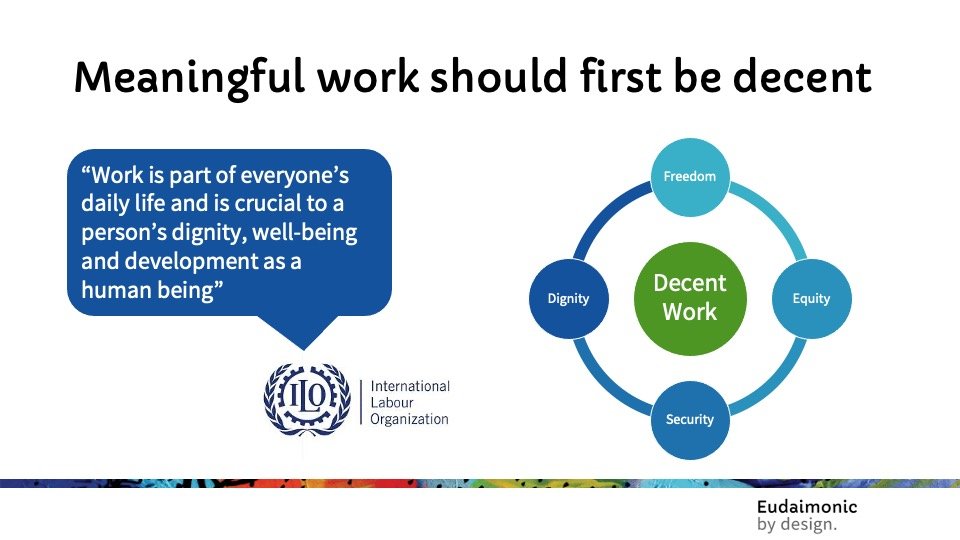
  • Decency as foundation: The International Labour Organization defines decent work as work that ensures equity, security, freedom, and dignity. Without these, flourishing is impossible.

  • Moral community: Rituals, leadership, and culture should nurture virtue, justice, and mutual recognition.

  • Scale matters: Aristotle believed the polis must be small enough for intimacy and accountability. In practice, Soren observes, smaller organizations often do better at cultivating eudaimonic workplaces than sprawling corporations.

Act IV: The Business Case for Eudaimonia

Of course, no organizational change takes root without a business case. Fortunately, the evidence is strong.

Research shows that eudaimonic well-being correlates with:

  • Better health and longevity (which translates into fewer absences and lower healthcare costs).

  • Improved performance at both individual and team levels.

  • Greater engagement, loyalty, and innovation, which help organizations attract and retain top talent.

  • Financial outcomes, as studies at Oxford reveal - companies high in employee well-being consistently beat market averages.

At the same time, Soren cautions that while eudaimonia may boost performance, framing it only as an economic strategy undermines its moral foundation.

Treating human dignity as a means to higher productivity risks trapping organizations in what philosopher Alasdair MacIntyre called the “morally hollow iron cage” of modern business.

The real case for eudaimonia is ethical: workplaces should foster human flourishing because it is the right thing to do.

Act V: Reclaiming the Soul of Work—AI, the Arts, and Storytelling

Looking to the future, Soren warns that emerging technologies like AI may strip even more meaning from work, creating what anthropologist David Graeber called “bullshit jobs.” Without careful design, AI could deepen inequality and erode the soul of work.

So what can counterbalance this risk? The answer, Soren suggests, lies in the arts and storytelling. Far from being luxuries, they cultivate the reflective, relational, and imaginative capacities we need to flourish:

  1. Sharpening discernment of complexity.

  2. Building emotional sensitivity and care.

  3. Expanding moral imagination to envision alternatives.

  4. Integrating intuition and vision into wise action.

  5. Prompting critical reflection on whether we’re living our values.

The arts and humanities—often underfunded and undervalued—are essential for developing the human capacities most at risk in an AI-driven world. Stories, too, are not just communication tools but moral infrastructures. They shape culture, transmit values, and enable collective healing.

If we want eudaimonic workplaces, Soren argues, we must treat storytelling as a sacred practice. One that reveals shared purpose and binds communities together.

Act VI: Conclusions

As Soren notes, building workplaces as moral communities will not happen all at once. Designing workplaces as moral communities, or modern-day poleis, means:

  • Moving beyond self-optimization toward collective flourishing.

  • Treating organizations not as economic machines but as spaces for ethical, aesthetic, and human development.

  • Recognizing that even small shifts, led by committed communities, can ripple outward into real change.

Across workplaces and communities, leaders and workers are already experimenting with ways to make work more decent, purposeful, and humane.

The challenge is to notice, share, and build on these efforts - together.

The Risks and Rewards of AI for Well-Being: Lessons from Llewellyn van Zyl

On this episode of Meaningful Work Matters, Andrew speaks with Llewellyn van Zyl, a positive organizational psychologist and data scientist who is reshaping how we think about employee well-being.

As a professor at North-West University and Chief Solutions Architect at Psynalytics, van Zyl combines deep expertise in positive psychology with hands-on experience in analytics and machine learning.

In this conversation, he explains why traditional top-down models of well-being often fall short, and introduces a bottom-up, person-centered approach that treats every individual as unique. He also explores how artificial intelligence might help scale these insights, what risks and ethical concerns come with that, and what it all means for the future of work.

Why Top-Down Models Fall Short

For decades, much of positive psychology has relied on “top-down” models of well-being, such as the PERMA framework. These approaches assume that experts can define the components of well-being, design measurement tools, and then apply them across contexts.

While useful for prediction and creating shared language, van Zyl argues that these models break down in practice.

The problem is that what counts as well-being is not universal. A framework developed in the United States may not hold in Saudi Arabia, or even across subgroups within the same country. In one study, half of the psychological strengths identified by LGBTQ+ participants did not appear in the VIA Strengths model. Pride, for example, emerged as a critical strength, even though psychology often labels it as a vice.

Context matters, and averages fail to capture the lived realities of individuals.

Top-down models also treat well-being as static, impose narrow categories, and depend on self-report measures that often mask what people are actually experiencing. Van Zyl points out that someone may show all the physiological signs of burnout while still rating themselves as “a little stressed” on a survey.

A Bottom-Up Approach to Well-Being

Van Zyl offers an alternative: a bottom-up, person-centered perspective.

Instead of imposing categories from above, this approach starts with the individual and builds outward. He describes eight principles that make up this way of thinking:

  1. Every person is unique. Each individual is a case study of one, shaped by their own history, drivers, and experiences.

  2. Context matters. External conditions directly influence well-being.

  3. We are embedded in systems. Families, workplaces, and policies both shape and are shaped by individuals.

  4. Well-being is a process, not a snapshot. It unfolds over time and fluctuates in response to experiences.

  5. We need multiple perspectives. Stories, objective indicators, physiological data, and even traditional surveys all contribute to a fuller picture.

  6. It is co-created. Insights emerge through dialogue between individual and practitioner, not imposed by one on the other.

  7. Meaning is personal. The same factor can enhance one person’s well-being while detracting from another’s.

  8. Validation happens at the individual level. What matters is whether the model resonates as true for the person themselves.

These principles make clear why one-size-fits-all solutions rarely succeed. As van Zyl explains, the same experience can mean opposite things to different people. For one person, waking up at 3am may be a sign of insomnia. For another, it is a cherished time to join a Bible study group in another timezone and feel connected to their community.

Can AI Help?

If bottom-up approaches are the most accurate but also the hardest to scale, how can they be applied in practice?

This is where van Zyl’s work with artificial intelligence comes in. By analyzing thousands of personal narratives, his team has trained models to identify themes, cluster experiences, and even predict outcomes like burnout with surprising accuracy.

For example, language analysis showed that certain “high risk” words correlated strongly with burnout. Sentiment analysis revealed that the balance between personal demands and resources could explain additional variance. Taken together, these models could estimate burnout risk without relying on traditional surveys.

The goal is to create hyper-personalized assessments that capture what uniquely drives or detracts from each individual’s well-being.

Eventually, these assessments could generate equally personalized interventions, though van Zyl acknowledges that designing content to match each person’s profile remains a significant challenge.

Risks, Ethics, and Boundaries

As powerful as these tools can be, van Zyl and Soren emphasize the risks.

AI can deepen inequalities, erode uniquely human skills, and displace the personal connection that is central to care. There are also profound ethical concerns around data ownership, transparency, and consent.

Van Zyl stresses that individuals must remain at the center. People should know what is being tracked, why it is being used, and how long it will be stored. Without informed consent and clear ownership, even the most sophisticated models risk becoming exploitative.

Soren connects this to lessons from Sara Wolkenfeld’s episode, where she draws from Jewish teachings about the difference between rote work and sacred work. In the same way, we must decide what tasks we are willing to outsource to machines, and what forms of “sacred work” (such as, creativity, ethical discernment, human connection) we must hold onto ourselves.

Designing the Future of Work

Van Zyl believes AI should be used to augment, not replace.

It can handle pattern recognition, data analysis, and repetitive tasks, freeing people to focus on the parts of work that truly require human judgment and care. The challenge is not just technical but ethical: ensuring that these systems are designed intentionally, with safeguards to prevent harm.

As Soren reflects, the future could go two ways.

Left unchecked, AI might reduce work to hollow oversight of algorithms. But with thoughtful design, it could expand access to care, provide individualized support, and elevate the human aspects of work that matter most. He describes it as letting AI serve as an assistive tool, like a bionic arm that extends our capabilities, rather than a replacement for the uniquely human skills that give work meaning.

Key Takeaways

  • Top-down models of well-being overlook cultural and personal differences.

  • A bottom-up approach treats each person as unique, embedded in systems, and evolving over time.

  • AI and machine learning can help scale these insights, but they raise risks around ethics, dependency, and dehumanization.

  • Context and meaning shape how the same experience impacts well-being.

  • The future of work depends on using technology to enhance, not replace, what makes us human.

This conversation challenges assumptions about how we measure well-being and invites us to think critically about the role of AI in the workplace. By blending rigorous critique with a vision for what is possible, van Zyl offers both caution and inspiration for designing the future of meaningful work.

The Double-Edged Sword of Meaningful Work: Lessons from Andrew Soren

In the bustling world of work and productivity, the quest for meaningful work has become a north star for many. But is all meaningful work beneficial?

Andrew Soren, founder of Eudaimonic by Design, hosts the debut episode of Meaningful Work Matters, which delves into the intricate dance between the highs and lows of engaging in work that matters deeply to us.

The Allure of Meaningful Work

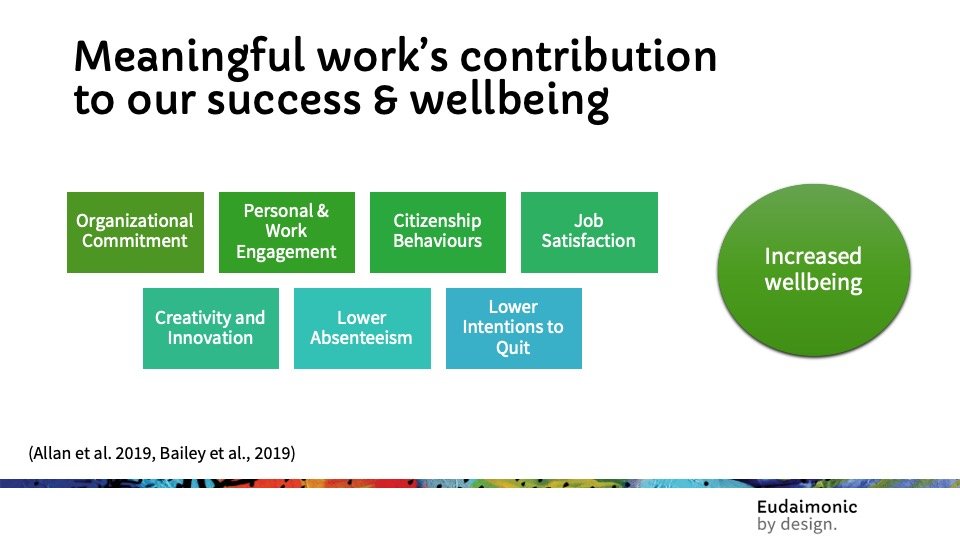
Meaningful work is not a luxury but a fundamental component of our well-being. As Andrew elucidates, work that feels significant and worthwhile can enhance our commitment, engagement, and satisfaction. The benefits extend beyond the personal sphere, fostering a culture of creativity, innovation, and altruism within organizations.

The Hidden Costs

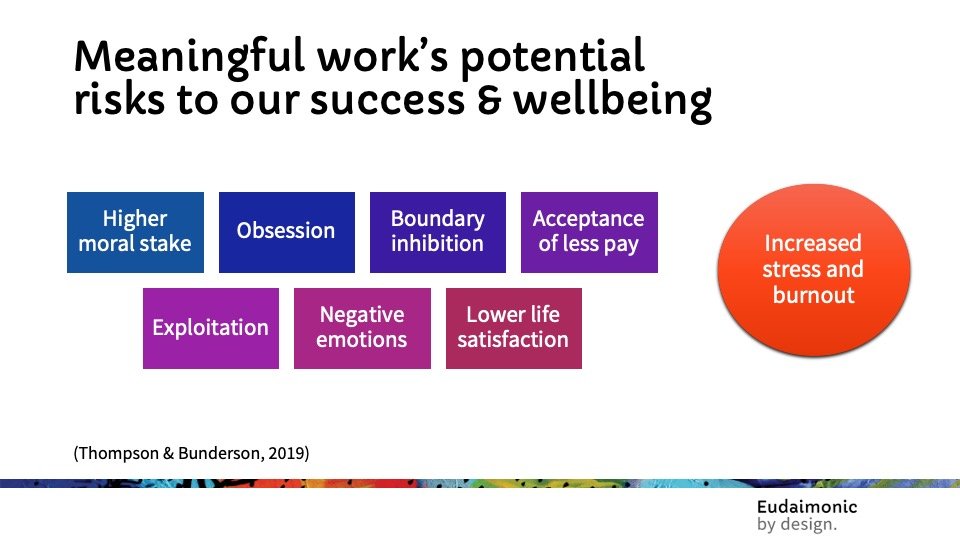
The research also reveals the dark sides of meaningful work: the potential for exploitation and burnout. When work has a high moral stake and becomes an obsession or when employers leverage our passion without decent working conditions, meaningful work can transform from a source of fulfillment into a wellspring of dissatisfaction, stress, and burnout.

The Crucial Element of Decency

Central to the discussion is the concept of "decent work" - safe, equitable, and dignified work. Drawing from the principles set by the Industrial Labor Organization, Soren advocates for a balance between meaning and decency. He argues that meaningful work, devoid of decency, can lead to exploitation and burnout. Conversely, work grounded in respect, equity, and security paves the way for true fulfillment.

Navigating the Path Forward

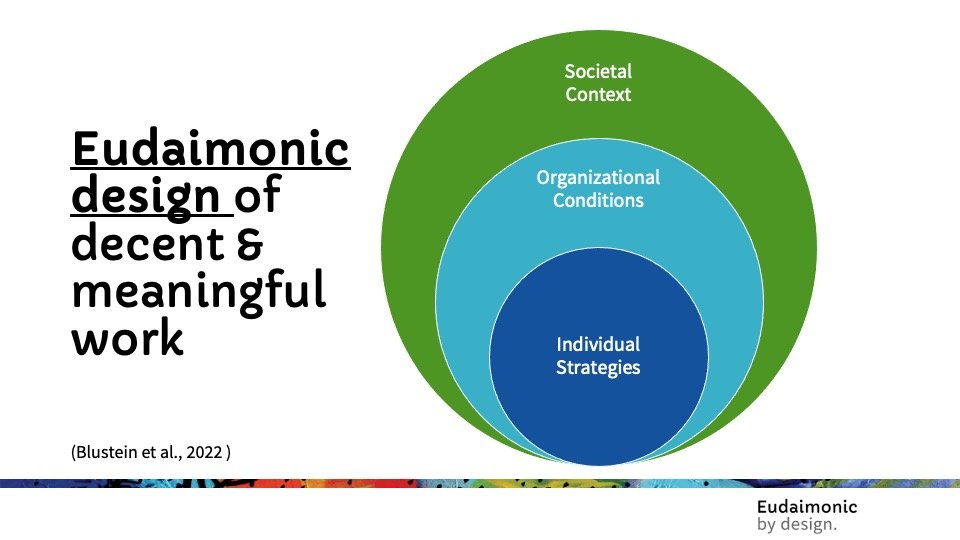
Andrew presents a blueprint for cultivating environments where meaningful and decent work can thrive. We need policies and regulations to ensure decent working conditions for those engaged in meaningful work. In organizations, we can design the cultures, practices, and leadership behaviors that enable those engaged in meaningful work to thrive. At the individual level, we can create interventions to help people understand what makes work personally significant and worthwhile and craft work that makes the most of an individual's strengths, values, and passions.

Your Role in Shaping Meaningful Work

As listeners, we're invited to reflect on our workplace and community roles. Whether you're a leader, policymaker, or team member, this podcast encourages you to consider how you can contribute to a more equitable and fulfilling work culture.

Join the Conversation

Meaningful Work Matters is not just a podcast; it's a call to action. As we navigate the complexities of the modern workforce, let's engage in conversations that matter. Share your thoughts, experiences, and aspirations with us. How do you define meaningful work? What steps can we take to ensure that work is meaningful and decent?

Visit our Resources page for insights and discussions on creating a better world through meaningful work. Together, we can make work a source of joy, growth, and fulfillment for all.

Resources to explore:

Unlocking Your Best Self Through Positive Psychology

 A discussion about the gift of guiding others' curiosity and passion in a way that allows them to recognize their greatest strengths.

Join Eudaimonic by Design CEO Andrew Soren and host Dr. Jason ZW Powers on the Positive Recovery MD podcast, where they discuss a range of topics, including:

  • The significance of daily gratitude and how to cultivate a gratitude practice

  • The meaning of awe and how it can help rewire our mindset

  • How positive psychology is the science of what goes right in our lives

  • The value of intent and deliberate action to when faced with challenges

Learn the ways in which these concepts and positive psychology can help individuals transcend life’s challenges and live more fulfilling lives.


Find the episode on Apple, Spotify, and iHeartRadio.


Listen Now


Sign up to our Resource Library

Get first-hand access to our rich resources, exclusive insights, and the latest updates from thought leaders in resilience. Enhance your understanding and stay ahead with EUBD.

How to spark meaningful conversations in the workplace

How to spark meaningful conversations in the workplace

Join our webinar to be part of the conversation and learn what we can do as HR leaders to help people thrive and feel truly connected, engaged and fulfilled at work and beyond.