
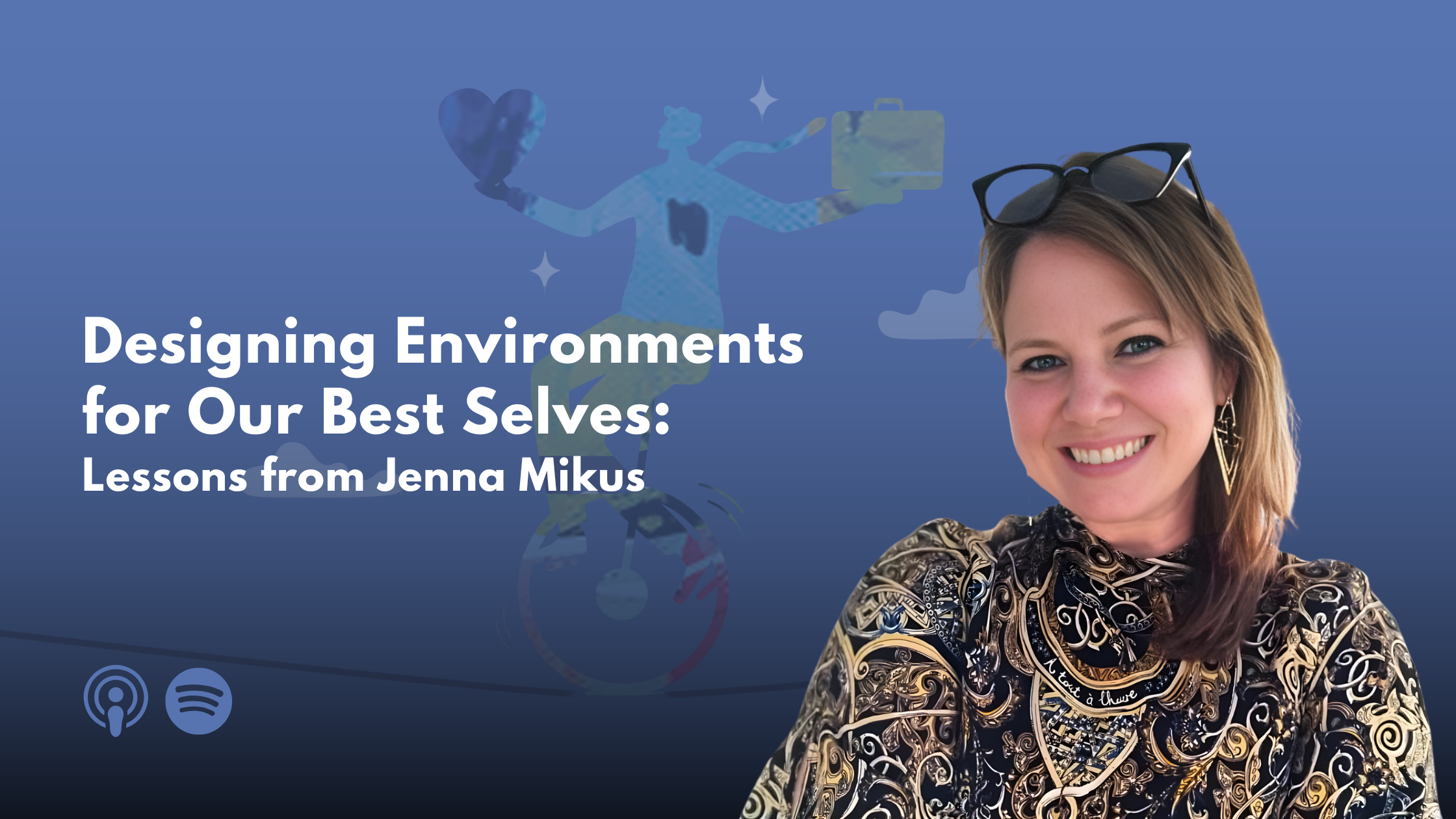
In this episode of Meaningful Work Matters, Andrew sits down with Jenna Mikus to explore what it means to design environments that support human flourishing. Jenna is a strategic advisor and researcher whose work bridges architectural science, wellbeing science, and organizational design, helping organizations think differently about how space shapes human experience.
Together, they examine how environments influence our ability to grow into our best selves and why meaningful work emerges not only from roles and relationships, but also from the conditions we design around people every day.
Moving Beyond Function Toward Flourishing
The conversation opens with a shared recognition that most environments are designed to function, not to help people flourish. Mikus reflects on how much of her early consulting work focused on efficiency, systems, and performance, even as she noticed how deeply space influenced human behavior and wellbeing.
This tension eventually pushed her toward a different question. What if design started with the goal of supporting people in becoming their best selves, rather than simply managing behavior or output?
Mikus describes discovering Aristotle’s concept of eudaimonia as a turning point. Unlike happiness or comfort, eudaimonia emphasizes growth, agency, and alignment over time. That framing helped her articulate what she had long sensed in practice. Environments quietly shape who we become.
As Mikus puts it, “Buildings and spaces are not neutral. They either help or they hinder.” Meaningful work, in her view, depends on whether environments support that deeper process of becoming.
The Interplay Between Structure and Agency
As the conversation deepens, Soren and Mikus explore the balance between what organizations design and what individuals bring to their work. Mikus resists the idea that flourishing can be engineered or prescribed. At the same time, she challenges the notion that wellbeing rests solely on individual responsibility.
Instead, she describes an ongoing interaction between structure and agency. Organizations create conditions through space, policy, and culture. Individuals respond by crafting how they engage with those conditions based on their needs, values, and life stage.
Mikus shares insights from her research with older adults during the pandemic, where participants did more than describe ideal spaces. They began taking action, reorganizing their homes, reconnecting with family, and engaging more intentionally with their environment. The design process itself sparked intrinsic motivation.
“That intentional praxis activated people,” Mikus explains. “It wasn’t just about the space. It changed how they related to themselves and their lives.”
For meaningful work to take root, both sides matter. Supportive environments without agency feel controlling. Agency without support becomes exhausting. Eudaimonic design holds these tensions together.
Inclusive Design as a Foundation for Meaningful Work
The conversation then turns toward inclusion as a core condition for flourishing. Mikus describes how inclusive design starts by designing with people rather than for them, particularly those on the edges of a group or population.
Drawing on design for all research, she explains that when environments work well for older adults, neurodivergent individuals, or those with sensory sensitivities, they tend to work better for everyone. Choice, flexibility, and dignity support autonomy and belonging across differences.
Mikus emphasizes that inclusion does not require designing everything for everyone all the time. It requires offering options. Different places to focus, connect, move, or rest allow people to meet their needs without explanation or justification.
In the context of meaningful work, this approach challenges rigid norms about how and where work should happen. Inclusive environments make it easier for people to participate fully and sustainably.
Why Sensory Experience and Awe Matter
Mikus introduces the role of awe, delight, and sensory experience in the design process. She reflects on how light, sound, texture, and movement influence how people feel in a space, often before they consciously notice.
Rather than treating these elements as aesthetic extras, Mikus frames them as contributors to motivation and meaning. Experiences of wonder or curiosity can invite people into deeper engagement with their work and with one another.
She cautions against superficial applications, noting that awe cannot be manufactured through spectacle alone. Instead, it emerges when environments feel thoughtful, layered, and responsive to human experience.
“There is a difference between meeting needs and creating experiences,” Mikus says. “Flourishing often lives in that ineffable space.”
Soren connects this insight back to meaningful work, noting that people rarely feel inspired by environments designed only for control or efficiency. Sensory richness creates room for creativity and connection.
Designing for Change Over Time
As the conversation continues, Mikus returns to the idea that flourishing is dynamic. People change, roles shift, and needs evolve. Design that assumes stability quickly becomes misaligned with lived experience.
Mikus argues for adaptability as a core design principle. Environments should invite feedback and evolve alongside the people who use them. This applies to physical space, but also to organizational systems and norms.
By acknowledging change as inevitable, organizations reduce the pressure for people to conform to fixed expectations. Meaningful work becomes more sustainable when environments support growth rather than resist it.
What This Means for Leaders and Practitioners
For leaders, Mikus encourages a shift from asking how to motivate people to asking what conditions make motivation more likely to emerge.
For designers and practitioners, the episode reinforces the value of interdisciplinary thinking. Architecture, psychology, organizational design, and philosophy all contribute to understanding how environments shape experience.
For individuals, the conversation offers a reminder of agency. Even within constraints, people can reflect on how their environments support or undermine their wellbeing, and advocate for change where possible.
Designing Work That Supports Our Best Selves
Meaningful work takes shape in the everyday experience of space, choice, connection, and growth.
Mikus’s work reminds us that environments quietly teach us what is possible. When we design with intention, inclusion, and care, we create conditions where people can flourish. And when people flourish, meaningful work follows.