
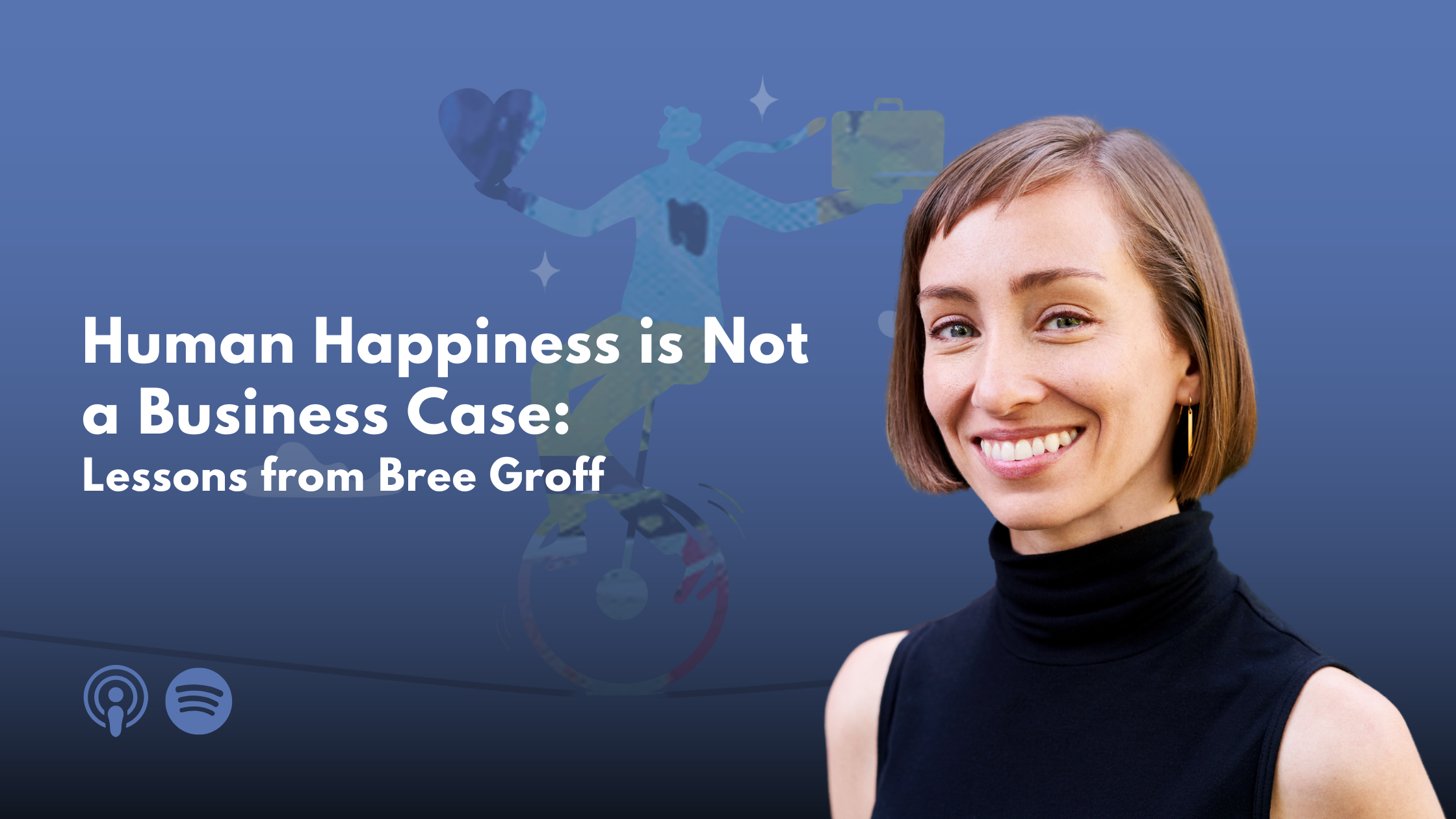
On this episode of Meaningful Work Matters, Andrew speaks with Bree Groff, a workplace culture expert and author of Today Was Fun: A Book About Work (Seriously). Drawing on years of experience guiding leaders through complex change, Groff has developed a clear view of how the rhythms and expectations of work shape people’s lives.
In their conversation, she and Soren explore why happiness at work deserves to be valued on its own terms, how burnout often reflects structural problems rather than personal shortcomings, and what simple practices help teams build more humane and sustainable ways of working.
When Happiness Needs a Business Case
A central theme in Groff’s work is her discomfort with the way organizations try to justify happiness.
Leaders often rely on metrics that translate well-being into productivity, profitability, or retention. These arguments are familiar in corporate life, yet they reveal how easily we treat happiness as something that must earn its place. When well-being becomes a means to an end, it loses its standing as a fundamental part of a good working life.
Engagement, as Groff describes it, is simply human happiness in business language. Treating it as something that needs economic validation overlooks the finite nature of a workday and the fact that its value cannot be measured by what it produces.
This point echoes a prior conversation on the podcast with Zeynep Ton, who outlined the moral, strategic, and competitive reasons organizations often use to justify good jobs. Groff builds on that idea by emphasizing how easily the moral argument becomes the quietest one in the room.
Her perspective comes from lived experience caring for family members with serious illness and reflecting on the time she shared with colleagues who have since passed. Those moments sharpened her sense that leaders are responsible for shaping days people can feel good about, not just days that generate output.
Why Burnout Can Reflect Broken Systems
This lens naturally leads Groff to the topic of burnout.
She believes burnout often reveals deeper structural issues rather than individual weakness. Chronic overwork signals that the organization’s math is not working. The business model demands more hours than human beings can sustain. Leaders may not see the personal consequences, yet those consequences are real. Missed family time. Rising stress. Compromised health. Loneliness.
Groff draws a distinction between effort and exploitation.
Hard seasons can be energizing when teams feel supported, connected, and united in purpose. She remembers moments when her teams worked nights or weekends to prepare for a major milestone. These periods were demanding, but they were also joyful because people laughed together, shared meals, and felt part of something meaningful. The problem is not effort, but the expectation that effort must be constant.
Leaders must revisit priorities, negotiate realistic timelines, and examine how much work the system can truly hold. When an organization depends on a steady stream of personal sacrifice to succeed, something fundamental needs to change.
A More Human Approach to Leadership
Groff offers practical ways leaders can support well-being without relying on grand programs or costly initiatives. Many of her suggestions revolve around reclaiming time, presence, and honesty.
One of her simplest practices is called “golden time.” Employees can block time on their calendars for anything in their personal lives that needs space, whether it is school pick up, a therapy appointment, or simply time with someone they care about. Colleagues respect those blocks without asking for details, and in doing so, they collectively create a norm that people’s lives outside of work matter and do not need justification.
Groff also encourages leaders to be intentional about how they shape the rhythm of the workday. On her teams, she sets a two hour block for collective deep work to give everyone uninterrupted space to think and create without the constant pull of Slack, email, or meetings. She and the project manager handle any urgent client communication during this window, which protects the rest of the team’s focus and helps them do the kind of work that benefits from calm, steady attention.
Another practice Groff highlights is the importance of naming what people are experiencing during difficult stretches of work. When teams are overloaded, silence can create isolation and make exhaustion feel like a personal failing. Groff encourages leaders to acknowledge the weight of the moment, not to dramatize it, but to help people feel less alone. A simple reflection like “This is a lot right now” can open the door for honesty, support, and shared resilience.
The Tension Between Well-Being and Impact
A steady theme in Groff’s perspective is the idea that well-being and meaningful work strengthen each other. Work can require real effort, yet effort does not have to come with depletion. Many leaders worry that caring for people will slow progress or soften ambition, but Groff sees care as the foundation that makes sustained performance possible.
She notes that pressure and purpose can sit side by side. People can work intensely without losing themselves, but only when the environment allows for recovery, clarity, and emotional steadiness from their leaders. Without those conditions, effort shifts from contribution to exhaustion.
Both Soren and Groff point out how often organizations frame burnout as an individual problem. Employees receive guidance about resilience or self-care, while the system continues to ask more than anyone can reasonably give. Groff encourages leaders to take responsibility for the structures and expectations that shape people’s days, because meaningful work only takes root when teams have the capacity, support, and energy to engage with it fully.
Reclaiming the Value of Time
Groff returns to the belief that human days carry their own inherent worth. A day spent working is still a day of someone’s life, and once it passes, it is gone. Leaders who understand this begin to approach time with more care and humility. Leadership becomes the work of creating conditions where people can contribute meaningfully without trading away their health or sense of self.
Groff describes this kind of leadership as a blend of boundaries, presence, and compassion. It means speaking up when priorities exceed capacity, standing with people during heavy periods of work, and making room for a full life beyond the office. It asks leaders to tell the truth about what is happening and to see people as more than their output.
This view roots performance in dignity. Groff reminds us that meaningful work grows in places where people feel supported, valued, and able to show up with their whole selves.
Final Thoughts
Groff invites us to see that work is part of life, not separate from it. Every workday becomes a chapter in someone’s story, and leaders shape the tone of that story in ways that often go unnoticed. When they honor the reality of people’s time, they create workplaces that feel more human. Expectations become more reasonable. Teams grow stronger because they face challenges together instead of struggling in isolation.
The value of a human day shows up in connection, dignity, and care. Groff’s work reminds us that when we protect those moments, we create the conditions where meaning can endure.